
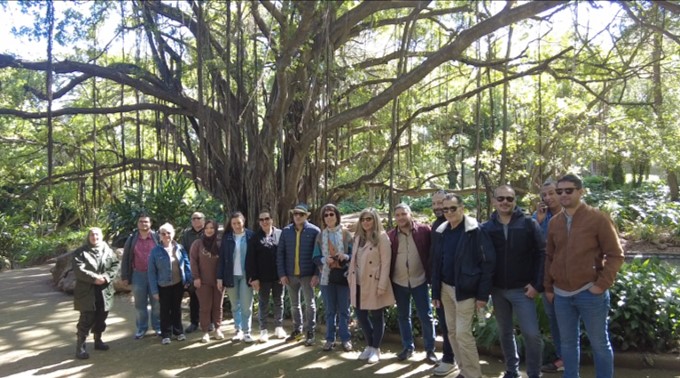
Nature-based Solutions are strongly related to ecosystem services and biodiversity. In this perspective, the botanical garden of Hamma, which is known as the Test Garden, is of particular interest for the study of plant communities and their ecological adaptations in changing environments. For this reason, the botanical garden was our first stop during the field trip to Djelfa on 1st of May 2024 in the framework of the fourth PRIMA funded Mara-Mediterra project meeting which took place in in Algiers, Algeria during 29-30 April 2024.
Our guide, Mr. Ammour Mhana, explained that already since its inception in 1832, the garden served as an experimental site for the growing of plant and tree species that were brought in from all around the world. We learn that a staggering over 6000 different species were brought in already well before the turn of the 19th century. Amazingly, records show that over 90% of the species survived in their new setting. Ammour further explained that the gardens were originally a marshland that was drained and are wedged between the Mediterranean Sea which brings in moist air that remains trapped due to the mountain ridge to the south. Over time, the garden continued to expand from an initial 5 hectares to 38 hectares of gardens and 20 hectares of arboretum which are overseen by the Algerian National Institute of Agronomical Research.
We started our visit from the French Garden, where the landscaping is based on the principles of symmetry and of imposing order on nature. We walk along pathways that are lined with bushes and trees that are trimmed into strictly geometric shapes. The alleyways that interlace the different sections of the French Garden are straight and named after the tree types, such as the dragon tree and bamboo, planted in straight lines along both sides of the respective alleyways.
The dominant role of architecture in gardens did not change until the 18th century, when inspiration started coming not from architecture but from romantic painting, which became known as the English garden. A constructed wetland, complete with a wooden bridge and a fountain with a nymph provide for a truly idyllic setting. As we walk through the English garden, we can sense it is much cooler and enables one to feel one with Nature. No surprise then that it provided the ideal setting for the shooting of Tarzan the Ape Man in 1932!

Snippets from the Mara-Mediterra Partnership visit to the Botanical Garden, and of the fourth project meeting including the field trip to Djelfa, can be accessed from this link.
This article was penned by Eng. Dirk De Ketelaere for Mara-Mediterra’s fourth e-Newsletter which was issued in July 2024 and which can be accessed in Arabic, English, French, Greek and Turkish.