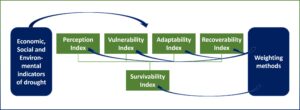
The “UNIfied framework to cope with droughts under MEDiterranean climate change conditions” – UNIMED project is part-funded by Xjenza Malta and the Scientific Technological Research Council of Turkey (TÜBITAK) through the MCST-TÜBITAK 2022 Joint Call for R&I projects. This initiative is part of the PRIMA Programme supported by the European Union.. Its aim is to develop a unified, indicator-based, framework to better assess, adapt and ultimately cope with agricultural droughts under Mediterranean climate change conditions. The framework consisting of a Survivability-of-Droughts Index is derived from the quantification of four underlying indices – perception, vulnerability, adaptability and recoverability. Each of these indices draws on a mutually exclusive set of relevant economic, social, and environmental indicators, ensuring that the assessment framework is aligned with the Water-Energy-Food-Ecosystem (WEFE) Nexus approach.
Over its 24-month duration, the project included three stakeholder engagement activities in both Malta and Turkey, organized in the form of Community of Practice (CoP) events which served a number of purposes. In addition to the testing and validation of the methodology, the events served to collect qualitative data from stakeholders such as their perception of droughts and of the impact of drought events in the agricultural sector. In adopting this approach, the workshops demonstrated that the voices and aspirations of local farming communities can be considered in the policy- and decision-making process.
During the workshops, the innovative qualitative knowledge management system of Systems Mapping was used. This methodology, devised by the EIT Climate KIC, which is a Knowledge and Innovation Community that strives to transition towards a more climate-resilient Europe, encourages the collection of novel insights into a given challenge or problem. The insights are generated through open round-table discussions and then mapped using visual tools. Through this approach, the UNIMED project engaged with relevant institutional entities in Malta and Turkey that are involved in the collection of economic, social, and environmental data pertaining to the present research, as well as policy- and decision-makers.
Agricultural experts and researchers were invited for the second Community of Practice event which took place on 5 April 2024 in Menemen, Turkey. Their expert opinion was invited to rank the weighting coefficients for each of the underlying indicator sets of the SDI, that is, the Perception, Vulnerability, Adaptability, and Recoverability Indices. This approach is known as inviting expert opinion to arrive at weighting coefficients. The results of this weighting exercise revealed that from the experts’ perspective, there are no dominant indicators.
Expert opinion was also sought on the level of methodological and societal readiness, and hence, the maturity of the Survivability of Droughts Index (SDI) and whether participating experts consider the concept is applicable also to other sectors beyond the agricultural sector. Two opinions emerged, one which considers that the SDI can only be applied to the farming sector whereas the second opinion holds that the SDI can be applied to other sectors and not just to the farming sector.
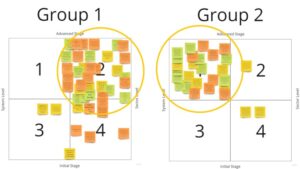
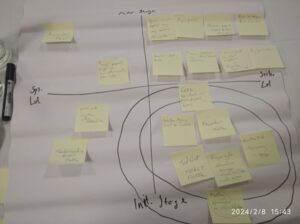
The participating experts agree that the SDI is an advanced-stage concept. Feedback from agricultural experts reveals that the SDI will be highly beneficial as it brings an integrated tool for farmers, researchers, decision-makers, and the general public in the scope of drought management plans, action plans, and prioritization of drought-prone areas. The figure below shows the visualisation of some of the outcomes from the 2nd stakeholder workshop in Turkey.
In Malta, the 2nd Community of Practice event, which took place on 8 February 2024, brought together stakeholders in the agricultural and water sector, including local farmers and researchers. The discussion focused on past and present projects that support the local farming community to cope with droughts. Participants identified possible obstacles to the identified projects and suggested solutions to change these barriers into opportunities. Synergies between projects were also identified. From this exercise it emerged that participants are knowledgeable about the subject of drought and its impact on the local agricultural community.
The 3rd stakeholder engagement activity in Malta, which was organized on 5 and 6 December 2024, assessed the interest of the agricultural community in drought and in nature-based farming, which offers solutions to mitigate the impact of a drought. Most stakeholders who participated in the workshop are aware of the challenge of drought. They associate drought with the scarcity of food. Other significant answers include climate change, water scarcity, and desertification. Drought is considered not only an agricultural challenge but also a problem of society. The absolute majority feel personally affected by drought and they are interested in the subject. Therefore, drought is indeed a subject of concern to the local agricultural community in Malta.
Nature-based farming was also discussed during the 3rd Community of Practice event, which participants linked to sustainability, health benefits, and better water management. Although the majority of stakeholders state that they do not often discuss these practices they believe that these should be the future for farming in Malta. All participants are interested in learning more about nature-based farming. Thus, it can be stated that there is increasing interest in nature-based farming practices which should be nurtured by policy- and decision-makers in drafting policy.
In conclusion, the UNIMED project has successfully developed the Survivability of Droughts Index (SDI), offering an innovative and integrated approach to assessing agricultural droughts under Mediterranean climate change conditions. Through extensive stakeholder engagement and qualitative analysis, the project has highlighted the importance of incorporating expert knowledge and local community perspectives into drought management strategies. The findings demonstrate that the SDI is not only applicable to agriculture but has the potential to be adapted for use in other sectors and regions.
By fostering collaboration among policymakers, researchers, and agricultural communities, UNIMED contributes to more effective drought preparedness and mitigation measures. The project’s insights align with the broader objectives of the Water-Energy-Food-Ecosystem (WEFE) Nexus and support the achievement of the United Nations’ Sustainable Development Goals (SDGs). Moving forward, further testing and refinement of the SDI in diverse contexts will strengthen its role as a decision-support tool for climate resilience and sustainable resource management.
