
Access this link to watch the video clip produced and narrated by Eng. Dirk De Ketelaere, entitled ‘Devising Nature-based Solutions to restore Lake Marmarma in Turkey’, which brings snippets from the field excursion and the participatory stakeholder engagement process that was deployed by the research team at the Dokuz Eylul University (DEU DESUM, Izmir, Turkey) in the Mara-Mediterra partnership.
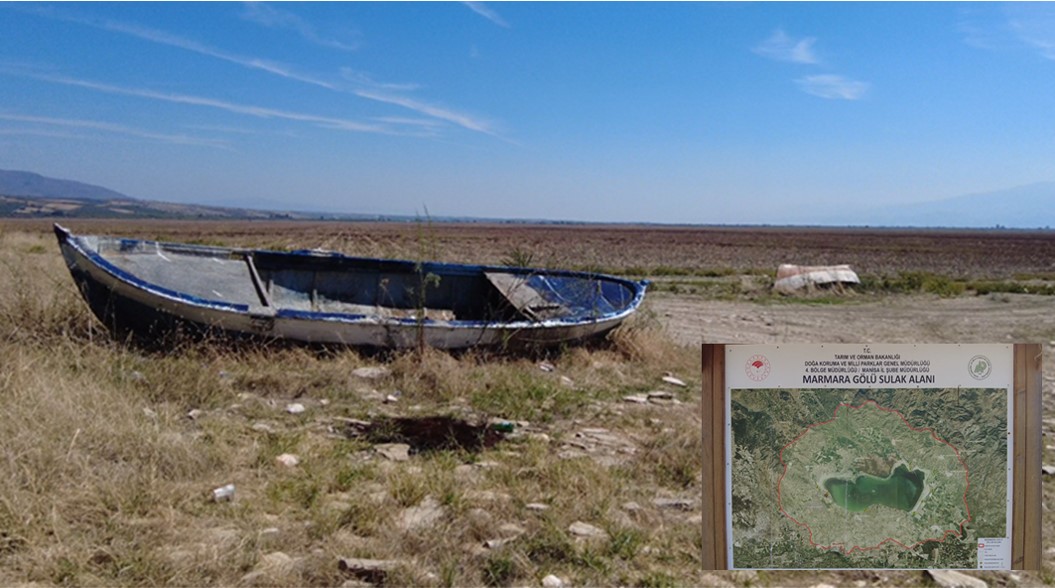
Lake Marmara, a wetland of international importance due to its rich biodiversity, in particular in terms of bird species, dried out due to a sequence of ill-conceived interventions, which included the construction of the Gördes dam. The agricultural area around the lake is well-known for its production of sultanas, i.e. dried white grapes, which are exported worldwide. Our first stop during the field excursion on 26 September 2024, is the Ahmetli weir, the largest weir on the Gediz River constructed back in the 1970s with an aggregate command area of 60,000 ha of agricultural land. The drying out of the lake caused the river flow to become very low. This severely disrupted the rotation that was previously applied by means of the weir to provide all the agricultural areas with the required irrigation water.
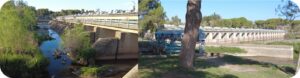
At the Gördes dam, we witness the very shallow depth of the water stored behind the dam, while its downstream part had silted up and formed large sand banks.
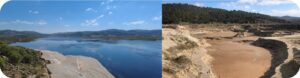
Our final stop is at the ‘port’ of the lake, where fishermen used to bring their catch, as evidenced by the many boats that now lay stranded on the land.
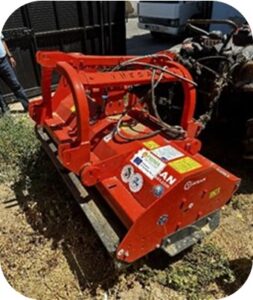
Dr. Cem Polat Cetinkaya, DEU-DESUM’s Teamleader, explained how conflicting interests proved an obstacle to organize a meeting with all stakeholders already since the start-up phase of the PRIMA funded Mara-Mediterra project. With the support of the Chairman of the Agricultural Chamber, Erdal Ziyan, 89 farmers joined the roundtable organized by DEU-DESUM in Gölmarmara to mark World Water Day in 2023 to ‘make their voices heard’. The farmers foremost pointed out that having to rely on the pumping of groundwater for their irrigation needs, not only the groundwater levels were falling rapidly, but also the groundwater quality was deteriorating at an alarming rate, thus presenting a huge challenge to safeguard their livelihood. It is especially noteworthy that the roundtable discussions revealed that no less than 7 NbSs were already being implemented by the farmers in an effort that was primarily aimed at reducing their irrigation needs and increasing the nutrients in the soil. A Living Lab was launched to trial and validate further agro-ecological practices such as mulching using equipment provided to the farmers through PRIMA funding (see Figure on the right).
The Living Lab members also joined in the Participatory GIS Practice sessions organized by DEU-DESUM with the purpose of mapping the agricultural field plots in which NbSs were already being applied and delineating the plots where additional practices are foreseen to be implemented. The latter comprises three distinct NbSs: agroforestry around the Gördes dam through the cultivation of olive trees in combination with a frost-resistant fig species which produces figs with a high market value; maintaining a minimum ecological flow to restore the lake once the water levels behind the Gördes dam will have risen, and the re-introduction of plant species, including seaweed, in the restored lake which will act as a natural treatment process to preserve the quality of the groundwater.
This article was penned by Eng. Dirk De Ketelaere for inclusion in Mara-Mediterra’s 5th e-Newsletter which was issued in January 2025 and be downloaded in Arabic, English, French, Greek and Turkish.