
In this video clip, Anna Spiteri shares the outcomes of field surveys combined with desk research conducted by IRMCo on the important roles of terraces in the rural Mediterranean landscape with a focus on the Maltese Islands’ rubble walls.
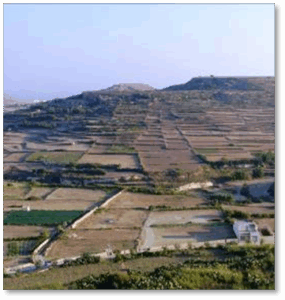
Rubble Walls, locally known as ‘Ħitan tas-Sejjieħ’, are a predominant and integral feature of the Maltese rural landscape. These traditional agricultural structures reflect the history, knowledge, and skill of our ancestral agrarian societies. For ages, Maltese farmers have realized the important role that these walls play in the preservation and sustainability of the local agricultural economy.
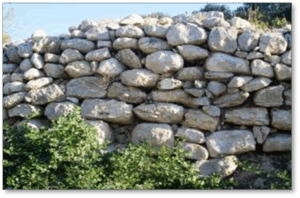
For ages, Maltese farmers have realized the important role that these walls play in the preservation and sustainability of the local agricultural economy. The use of terraced fields allows for sloping areas to be cultivated and is also designed as a means to slow surface runoff and prevent the soil from being washed away. In both Malta and Gozo, terracing supported by rubble walls has been used by the local farmers for many centuries. Rubble walls are ‘dry’ stone walls, that is, walls entirely built without the use of cement or mortar. Their stability comes from the skillful placing and fitting together of the stones.
In the Maltese Islands, early examples of ‘dry’ stonewalls can be seen around the entrances of the Megalithic Temples, dating back as far as 5000 BC, and also at the Bronze Age village of Borg in-Nadur.
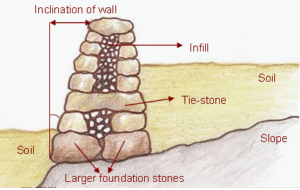
In her book, ‘Ħitan ta-Sejjieħ’, architect Elizabeth Ellul (2005) provides a detailed study of the construction methods, the tools employed, and the different types of rubble walls found on the islands. She identified three basic rules in the building of these walls:
- the largest stones are placed at the base of the wall, except those used as tie-stones,
- there should be an infill in between the two outer walls, and
- the wall has to incline slightly inwards as it goes higher.
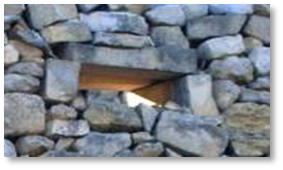
Additionally, flow holes can often be seen at the base of these rubble walls. Primarily these flow holes prevent the collapse of the walls by relieving the pressure of heavy storm water. They are mostly used in walls retaining clayey soils, since these soils tend to hold more water and expand, thus increasing the pressure on the surrounding walls.
In the testimonial video clip, Anna emphasizes that one of the most important roles of rubble walls is to prevent soil erosion. Soil erosion has always been a major concern and a threat to the sustainability of the agricultural sector in the Maltese Islands, where soil is a limited resource, and except for the fertile agricultural land found in valleys, soils are usually very shallow ranging in depths from 20 to about 60 cm.
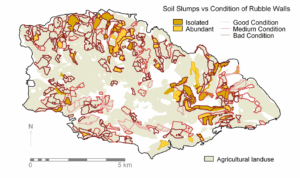
A field survey of rubble walls in Gozo carried out by IRMCo in 1999 in the context of the EU-funded International Cooperation (INCO) Project entitled ResManMed: Resource Management in Karstic Areas of the Coastal Regions of the Mediterranean, proved very enlightening in assessing the relationship between the condition of the rubble walls and the areas affected by soil erosion. The rubble walls were classified according to their condition, i.e., good, medium or bad. In parallel to this, the occurrence of soil slumps at the field level was recorded according to the following categories: isolated or abundant. As shown in the map below, the occurrence of soil slumps strongly correlates with the condition of the rubble walls on the island. The map clearly reveals that a high incidence of soil slumps was found predominantly in areas where the rubble walls were found to be in a poor condition.
The video clip forms part of a set of 11 testimonial clips by actors in Italy, Greece and Malta, informing about the benefits that can be reaped through the application of the agro-ecological practices promoted through the PRIMA funded Mara-Mediterra project. More details about the benefits of terracing can be found in the training set on this practice which can be accessed on the Mara-Mediterra project website through this link.